


After decades of effort, the federal government has finally gotten the message on geothermal power. Over the past several years, it has:
Authorized and funded EGS pilot demonstrations,
Extended geothermal investment and production tax credits,
Approved the 2 GW Fervo Cape project and held the largest BLM geothermal lease sale in over 15 years,
Established categorical exclusions under NEPA to streamline geothermal permitting by up to a year,
Made billions in potential loan authority available through the Office of Energy Dominance Financing,
Funded early-stage drilling and closed-loop innovation through ARPA-E,
Launched the FedGeo technical assistance initiative and Geothermal Power Accelerator with NASEO,
Elevated geothermal to a named priority in the energy emergency declaration,
And restructured DOE to house geothermal alongside hydrocarbons.
The combination of these efforts has led to the most favorable regulatory environment in decades. And, unlike the rest of the energy industry, which has reacted to the current demand spike with horror, geothermal is taking full advantage.
Given this fortuitous environment, I thought it would be worth taking the time to examine what state issues are most likely to block this rollout in an attempt to head them off at the pass. This post will focus exclusively on state-level burdens, as federal burdens have (1) already been significantly reduced, and (2) are already well covered by other policy work. It will also not cover areas that, while important to geothermal (e.g. interconnection and permitting reform), are broader reforms that just so happen to help geothermal.
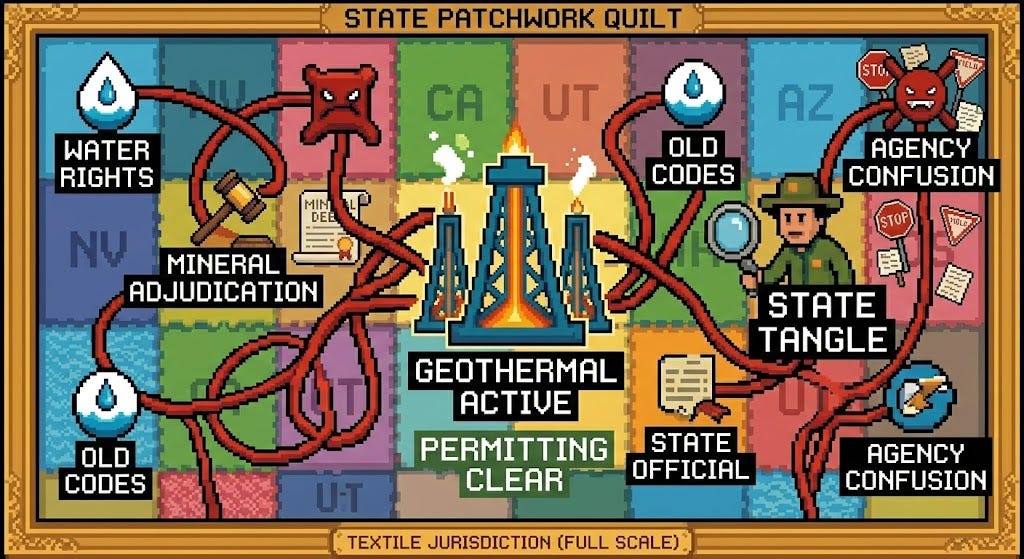
To put it simply, geothermal’s problem is that state laws and regulations were written for industries that extract things from the ground—mostly oil, gas, water, and minerals. New geothermal projects, from closed-loop to EGS, do not share this extractive nature. This makes them a poor fit for such laws and regulations. Because the fit to any particular category is poor, states classify geothermal resources haphazardly, open geothermal projects up to water rights adjudication risk, subject geothermal projects to onerous standards that don’t match their environmental footprint, and leave them in limbo about which agencies are responsible for permitting them.
None of these are the fault of any state in particular. The nature of any new technology is to share certain attributes with the old and differ on others. However, in the case of geothermal, states are currently choosing so differently that the patchwork currently being quilted is likely to serve as a serious barrier to scaling. In an attempt to provide clarity, the following will walk through the problems listed above step-by-step, starting with classification, discuss the potential solutions on offer, and then provide a potential solution for each. Solutions should be read as suggestions rather than firm reform recommendations here.
Classification
Before a geothermal project can be permitted, the state has to decide what the resource is. In most Western states, this determination is usually between one of two separate categories: surface estates and mineral estates. For a given piece of property, the surface estate covers the land itself; the mineral estate covers subsurface resources like oil, gas, and coal. The issue is that these estates are routinely held by different people. A rancher may own the surface while a mining company or distant heir owns everything below it. Geothermal does not fit cleanly into either estate, which is why states have reached for different analogies and ended up in different places.
Mineral estate states. California classifies geothermal as a mineral right, which means a developer must secure the mineral owner’s consent even if the surface owner wants the project. In split-estate parcels, that mineral owner may have acquired rights for oil or mining purposes and have no interest in geothermal, or may be hard to locate at all. Title searches, the process by which an individual determines who owns the property in question, are already expensive for oil and gas; for geothermal, where the legal basis for treating heat as a “mineral” is less settled, they carry the added risk that a court later disagrees with the classification as conveyed in a particular deed.
Surface estate states. Nevada and Washington take the opposite approach, giving geothermal rights to the surface landowner. This simplifies ownership, as locating surface owners is a much easier process. However, a mineral owner may still argue that geothermal drilling or fluid circulation at depth interferes with their subsurface rights.
Hybrid approaches. Other states have tried to split the difference. Colorado divides jurisdiction by depth: shallow systems stay under the State Engineer, while anything below 2,500 feet goes to the Energy and Carbon Management Commission. Texas consolidated everything under the Railroad Commission. Wyoming treats geothermal as underground water. Idaho, Montana, and Virginia each created standalone definitions that do not map onto any of these frameworks.
As you may have surmised, this system is a mess. Each classification produces a different set of parties who must consent before a project proceeds, and a different agency door to walk through. Under mineral-estate rules, developers negotiate with mineral holders and their lessees. Under surface-estate rules, the parties are easier to identify but subsurface conflicts persist. Under hybrid rules, a developer may need legal analysis just to determine which regime applies. When the industry was incubating, this was not an issue, as the need to scale across state lines was minimal. However, as it scales, this level of diversity will cause a substantial drag.
Potential Solution. One potential fix here is a voluntary model code, analogous to the UCC (Uniform Commercial Code), developed through the NASEO Accelerator with participating states. It should address at minimum whether geothermal attaches to the surface or mineral estate, how split-estate conflicts are resolved, and how the classification interacts with water law. A model code will give state legislatures a common reference point to adopt rather than forcing each to invent from scratch and going in completely different directions.
Water Rights
There is an additional wrinkle with the classification problem from section (1). There is an area of the law called water law, and every major Western geothermal state operates under a doctrine particular to it called prior appropriation. That doctrine says that the first user to put a flow of water to use holds the priority claim, and no latecomer can infringe upon their supply. This system was intended to manage the limited water supply in water-parched Western states. In theory, this shouldn’t matter for new geothermal systems, as reinjection withdraws fluid, extracts heat, and returns the fluid to the same formation. It does not consume the water in any meaningful quantity (except up front when creating the fractures), but prior appropriation does not cleanly distinguish between taking water out and passing it through.
Unfortunately, this gap means that developers who do not have a specific exception to point to face substantial legal risk. For a technology whose economics depend on front-loaded drilling capital and long payback periods, that timeline can make the project unfinanceable. Lenders are unlikely to underwrite a schedule that includes the possibility of a multi-year water rights adjudication.
States have tried to address this issue, but the solutions have been unstable so far. Nevada exempts reinjection-based operations from water appropriation permits on the theory that non-consumptive use does not constitute an appropriation. Assembly Bill 109 last year (2025) attempted to revoke that exemption, but did not advance. California’s Sustainable Groundwater Management Act may restrict geothermal activity where local agencies determine that sustainable yield is threatened. New Mexico explicitly authorizes existing water-rights holders to bring impairment actions against geothermal developers.
Potential Solution. States issue categorical determinations that reinjection-based geothermal operations are non-consumptive, paired with a statutory safe harbor preventing retroactive reversal. Prior appropriation already recognizes non-consumptive uses in other contexts, so the doctrinal basis exists. The safe harbor is the critical piece. Without it, developers face the Nevada problem, where one legislature’s classification can potentially be undone by the next, a real risk for such a capital intensive endeavor.
*There is a caveat here. Some geothermal operations do affect aquifer levels and temperatures even with reinjection, so any exemption should include monitoring tied to measurable aquifer impacts, with a mechanism for case-by-case review and liability imposition where warranted.
Permitting
The classification and water rights problems feed directly into a third. It’s everyone’s favorite issue: permitting. Given that most states have no geothermal-specific permitting process, the permits required for geothermal projects were almost certainly designed for the category it was placed in, not for geothermal itself. As a result, the forms, bonding requirements, review timelines, and compliance obligations reflect the risks of the inherited category rather than the risks geothermal actually presents. That mismatch then compounds across the multiple phases of a geothermal project, each of which imposes obligations intended to compensate for a different technology. The combination of these features makes geothermal permitting dramatically more burdensome than it should be.
Exploration. Exploration is where the gap between bureaucratic requirements and real environmental impact is largest. Site assessment (e.g. temperature gradient holes, seismic surveys, geologic mapping) is exceedingly light work, so light that much of it can be conducted from the back of an ATV. But in states regulating geothermal under oil and gas or mining law, a temperature gradient hole drilled to measure heat flow triggers the same application, bonding, and review as a production well. Those requirements are an enormous cost burden on a process that often needs to be run dozens of times to find a good drill-hole.
Drilling. This is the one phase where borrowing is largely appropriate. Deep drilling involves high pressures and wellbore integrity risks that are similar whether the well targets oil or heat. Small tweaks may need to be made to address additional heat and corrosion risks.
Operations. However, once the holes are drilled, a geothermal project diverges completely from a traditional drilling project. There is no commodity to extract, minimal produced water to dispose of, nor anything like the same spill risk. But for the most part, reporting, bonding, and compliance still assume that there is. Oil and gas forms are the most common example (forms sometimes even ask about projected hydrocarbon production), but the pattern repeats across every inherited category: consumptive-use appropriation permits for a non-consumptive activity, waste-disposal injection requirements for a sealed loop.
New York has kindly demonstrated both the problem and the difficulty of fixing it. Until 2023, closed-loop boreholes deeper than 500 feet required oil-and-gas drilling permits. Developers in the state were required to post well plugging bonds designed for oil and gas operations for sealed plastic pipes filled with antifreeze. Governor Hochul signed S. 6604/A. 6949 to exempt them, but the replacement geothermal-specific rules, due by December 2024, are still not in place as of this writing.
Potential Solution. States should draft flexible frameworks to tier permitting obligations to the actual risk at each phase. For example, exploration could require only notification and basic land-restoration commitments. Closed-loop boreholes could get a permit-by-rule structure. To implement such calibration, legislatures should designate a specific agency to develop geothermal-specific forms, bonding, and timelines within a statutory deadline with some teeth.
Agency Jurisdiction
Even if a developer knows what framework applies, there is often a much more basic problem: it is deeply unclear which agency is responsible for granting the permits. Because geothermal sits across several existing categories, it frequently lands in gaps between regulators, or in the overlap where several agencies each claim a piece and there is no single agency who owns the whole.
California, unsurprisingly, is the most instructive example. CalGEM (the state’s oil and gas regulator) permits geothermal resource wells on state and private land. The Department of Water Resources sets construction standards for heat exchange wells under a separate authority, which just so happen to be enforced by county departments. Then, local jurisdictions pile building, grading, and other well permits on top. Which agency controls a given project depends on well depth, operating temperature, and whether the system taps a defined geothermal reservoir or just ambient earth heat. That boundary is more than blurry enough to force a developer to approach three or four agencies before learning which one will actually process the application. And sometimes they will disagree on which agency this is.
Potential Solution. Statutorily pick one department to host all geothermal permitting.
Conclusion
The common thread through all four of these issues is straightforward: geothermal does not fit the categories states built, and nobody has built the right ones yet. This is good news! Political problems are tricky, policy ones less so. All we need is a little elbow grease. Time to get cracking.
Thoughts on Quaise?