


Where New York Is Now
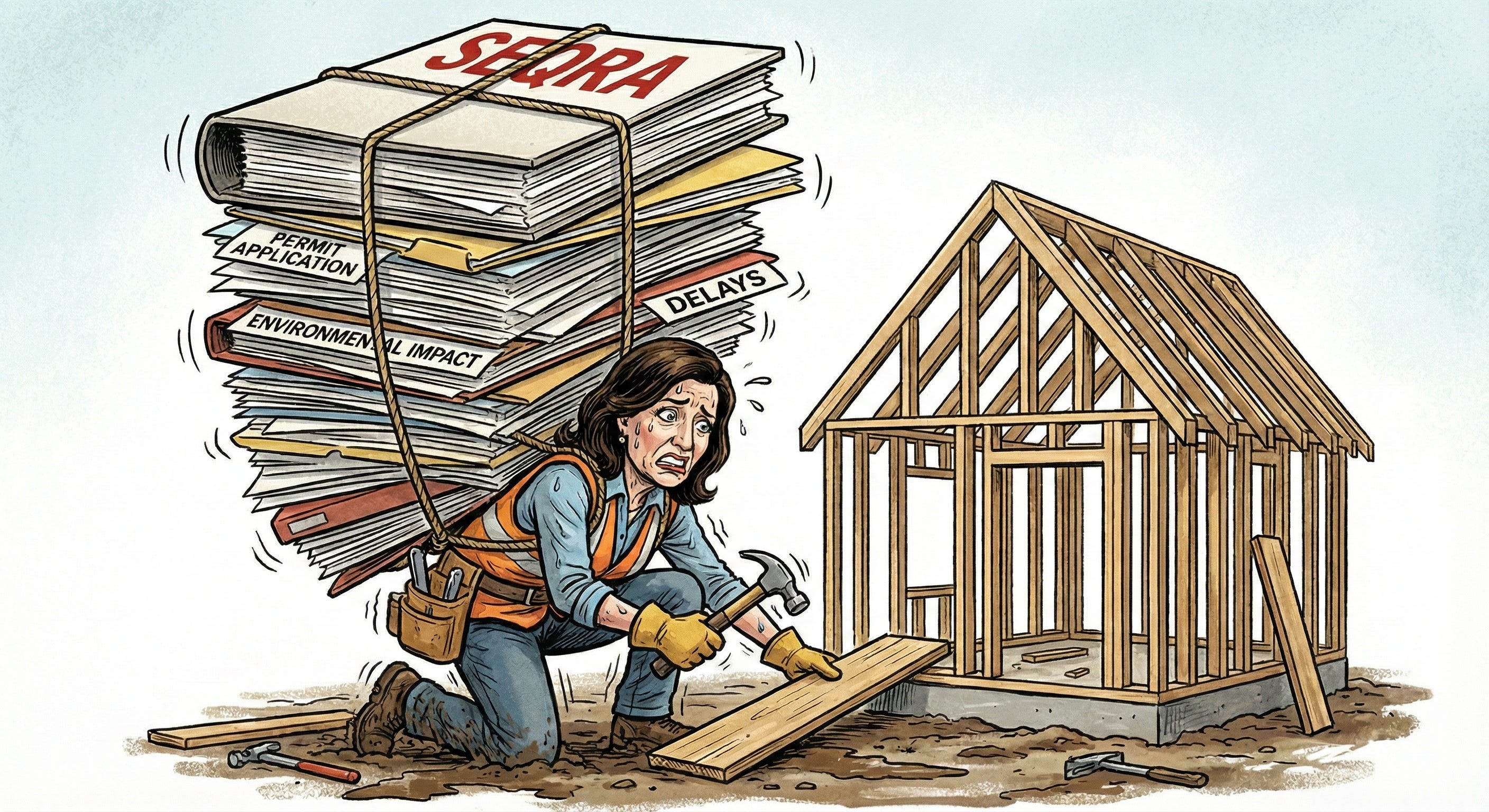
Permitting reform is finally on the table in New York. In her State of the State speech, Governor Hochul proposed the most significant reform to New York’s environmental review law (SEQRA) since it was enacted in 1975. The proposal would exempt housing projects of up to 250 units in New York City (500 in high-density areas), and up to 100 units elsewhere, from SEQRA review entirely.1 It would also impose statutory timelines on the environmental review process as a whole for the first time: one year to determine whether a full environmental impact statement is needed, two years to complete one. Given the scale of the proposal, it seems like a good time to give a brief explainer on what SEQRA is, what it requires, its structural flaws, and whether the proposed reforms are likely to succeed.
To start, the basics. SEQRA requires every state and local agency in New York to assess the environmental consequences of its actions before approving them. SEQRA borrowed its statutory structure from the National Environmental Policy Act of 1969, but with three major departures. It applies to local agencies, not just state ones. As a result, the hundreds of municipal planning boards and other public authorities that dot the state are all subject to environmental review obligations. It adopts a lower triggering threshold: review is required when an action “may have” a significant adverse impact, a probabilistic standard that forces agencies to act on possibility rather than certainty.2 And it embeds a substantive mandate that NEPA lacks. ECL section 8-0109 requires agencies to certify that adverse environmental effects will be “minimized or avoided to the maximum extent practicable.” This is the largest conceptual departure from NEPA, which federal courts read as purely procedural. New York’s statute, at least on its face, demands more.
Then there are the implementing regulations. These are codified at 6 NYCRR Part 617, and detail an in-depth sequential process of review. First, every action requiring agency discretion must be classified as Type I (presumptively significant, requiring a full environmental assessment form and coordinated review), Type II (categorically exempt), or Unlisted (everything else, requiring at minimum a short assessment and a significance determination). If the lead agency determines that the action may have a significant adverse impact, it issues what is called a “positive declaration,” triggering preparation of a draft environmental impact statement, public comment, a final EIS, and a findings statement certifying that impacts have been minimized. If it determines the action will not have significant impacts, it issues a negative declaration, and the project proceeds.3
The key problem with SEQRA is that this process is incredibly poorly matched with the structure of judicial review. The way SEQRA is set up, it both grants the agencies an enormous amount of discretion and makes the exercise of that discretion reviewable by a court. Each stage requires the lead agency to make a decision under an open-ended standard; however, each of these decisions is independently reviewable through an Article 78 proceeding in state court (at least if the outcome is a decision by the agency that the project can proceed). Further, each review is governed by the “hard look” doctrine established by the Court of Appeals in 1986.4 Under this standard, the agency must identify the relevant areas of environmental concern, take a hard look at them, and provide reasoned elaboration of its determination.5 In theory, this should be quite a deferential standard. The core question is “Did the agency reasonably use its discretion in the allocation of its resources for this specific project given its scope and scale?” However, in practice, these cases require case-specific examination of the administrative record. Such examination resists summary disposition, which means every challenge takes months to years to resolve regardless of its merit.
SEQRA’s Contestable Area
In an attempt to compress this concept into a usable format, I have taken to referring to it as “contestable area”: the aggregate surface area of litigable discretionary decisions, governed by fact-intensive review standards, arrayed across sequential stages, each independently actionable. The concept is distinct from ordinary statutory ambiguity. Almost all laws are ambiguous around the edges of their application. What makes SEQRA’s (as well as other environmental statutes) ambiguity distinctive is the multiplicative interaction of sequentiality, cost asymmetry, and a review standard that resists quick resolution. In short, the space of attack for any SEQRA decision is so large that you can almost guarantee that there is a colorable lawsuit available to delay the agency decision.
To demonstrate this concept, it is useful to walk through an example. For example, let’s say a 90-unit mixed-use residential development is proposed on a previously commercial site in the lower Hudson Valley. There are two involved agencies: the town planning board and the county health department. The project starts off Unlisted, falling below the presumptive Type I residential threshold of 200 units. The neighbors are opposed, and the site has no extraordinary environmental sensitivity.
The first litigable decision is classification. In this case, the developer owns an adjacent parcel. If the “whole action” includes a potential second phase on that parcel, the combined unit count might exceed Type I thresholds, presumptively requiring an EIS. Noticing this, a challenger argues the board impermissibly segmented the project under 6 NYCRR section 617.3(g). The board says that the parcels are independent. The key factor here is whether the segmented piece has “no independent utility.” This is a fact-intensive determination, requiring the court to examine the record.
The second is lead agency designation. This one can be ignored, but it is worth noting as it consumes 30 to 60 days of calendar time.
The third is the environmental assessment form. The planning board rates traffic impacts “moderate,” stormwater “moderate,” neighborhood character “moderate.” In part 3 of the form, the section where the board must explain why these moderate impacts do not rise to significance, the board writes five pages. A challenger argues this is conclusory, not reasoned elaboration. They argue that the board failed to conduct a traffic study or consider cumulative impacts from three other projects approved within a mile. Each impact category is independently contestable.
The fourth is the significance determination itself. After its deliberations, the board issues a negative declaration. This is the largest contestable area. After Chinese Staff confirmed that “environment” included socioeconomic impacts such as displacement and neighborhood character, virtually any development project presents arguable grounds for challenge. The standard, “may have a significant adverse impact,” does not specify a probability threshold, nor has an appellate court supplied one. The result is that the standard accommodates nearly any claim of potential harm that a competent attorney can put on paper.
If the board decides to play it safe and proceed with a full EIS via issuing a positive declaration, there would be another crop of litigable decisions: whether the scope adequately captured all significant impact categories; whether the draft EIS analysis was sufficient; whether the final EIS meaningfully responded to public comments; and whether the findings statement’s certification that impacts were “minimized or avoided…to the maximum extent practicable” was supported by the record. The Court of Appeals held in Jackson v. New York State Urban Dev. Corp., 67 N.Y.2d 400 (1986), that this language imposes a genuine substantive obligation. This means that agencies must actually minimize harm, not merely document that they considered it. But the court simultaneously held that it would not “weigh the desirability of any action or choose among alternatives.” To be blunt, these two conclusions are inconsistent and their tension has never been clearly resolved.
The combination of all of these decision points creates an incredibly large contestable area. For the 90-unit project, six theories of insufficiency could in theory be put forward: on classification, on the lead agency determination, on the extent of the EAF analysis, on the significance determination, and on the two components of the underlying land-use approval. Each of these decisions may contain enough fact-specific use of discretion to generate a claim sufficient to survive early dismissal motions.
How SEQRA Interacts with Litigation
The combination is crucial because of two features of the litigation environment. The first is cost asymmetry. The plaintiff needs to merely plead insufficiency. The defendant, the agency, has to compile and certify the entire administrative record (which can run into the thousands of pages). While this is going on, the project developer must pay the carrying costs of a frozen project for the duration of the litigation. This asymmetry means the expected value of filing a challenge is positive for opponents even at low probabilities of success, as long as the delay value exceeds the filing cost. If you are a neighbor who would like to see a project die, it usually does. The second is the financing freeze that comes along with lawsuits. It is true that there is no automatic stay of agency action upon filing an Article 78 petition; the approval remains legally effective unless the court enjoins the decision.6 However, even if an injunction is not issued, good luck finding a construction lender that will close on a loan while active litigation threatens to annul the underlying approval. This effectively limits the ability to proceed during a case to developers who can self-finance while bearing extraordinary downside risk.7
Returning to the 90-unit project, let’s play out the sequence. The neighbors file an Article 78 challenging the negative declaration. Then, the lender suspends the loan commitment and the project is halted. Fourteen months later, the court partially sustains the challenge: the board failed to address cumulative traffic impacts from nearby projects. The board commissions a $40,000 traffic study, completes a supplemental analysis, and then issues a new negative declaration. The delays total twenty months. Say the cost to the developers is approximately $100,000 in legal fees plus carrying costs. To be fair to the neighbors, according to the court, the board’s initial review was genuinely deficient. But the fix was a single $40,000 study. The remaining $60,000 and fourteen months bought nothing except the privilege of proving that in court.
For some useful numbers, the Citizens Budget Commission found in a 2022 study of 171 private zoning applications filed in New York City between 2014 and 2017 that the median approval time was 2.5 years, with 80 percent of elapsed time consumed by pre-certification and environmental review. They estimated that such review added 11 to 16 percent to total project costs, which would be approximately $58,000 per unit in low-rise multifamily and $67,000 per unit in high-rise construction.
Reform and Hochul’s Proposal
So, returning to Hochul’s proposal, is it likely to succeed? In a word, yes. The two categories of housing mentioned in the proposal would be statutorily excluded from SEQRA review (functionally similar to being added to the Type II list). No classification, no EAF, no significance determination, no Article 78 SEQRA challenge. For the 90-unit project, the delay would be eliminated entirely. By eliminating the agencies’ discretion to say whether a project may have an environmental impact, the proposal eliminates its contestability.
However, the proposal is a blunt tool that does very little for non-qualifying projects. A 600-unit development, or a 200-unit project on a greenfield site, faces the same steps with the same open-ended standards as it did before. Mandatory timeline caps may constrain the duration of the process (though I have my doubts) but do not narrow the grounds for challenge or accelerate judicial resolution. If Governor Hochul wishes to truly reform SEQRA, it will require massively shrinking the contestable area the statute provides. A good general principle to hold is: “If courts are not going to reasonably defer to agency discretion, agencies should not be granted that discretion.”
Fixing SEQRA more broadly requires either shrinking the ability of courts to challenge agency discretion or shrinking the scale of that discretion. Either something like Article 78 pleading requirements for SEQRA need to be heightened (there are other legal remedies here, this is simply illustrative) or agencies need to be given a more ministerial role (which functionally is what Hochul’s proposal does for the categories it covers). There are methods for both, such as exhaustion requirements or objective statutory thresholds for positive and negative declarations, but whatever the method, the goal is clear: shrink the contestable area.
There are further restrictions and complications here, particularly for coastal flooding zones, you can read the full proposal here (75-80).
To be quite honest, it’s unclear how much of a difference this makes versus the simple lack of experience with Article 78 actions by courts
This summary hides a substantial amount of complexity, but covers the broad categories. For more, you can read the SEQRA handbook here.
For those of you who are familiar with NEPA, you will be very familiar with the phrase hard look.
Chinese Staff and Workers Ass’n v. City of New York, 68 N.Y.2d 359 (1986); Akpan v. Koch, 75 N.Y.2d 561 (1990)
Statistics are hard to come by on this, however, given that irreparable harm is often a low bar for environmental harms, I suspect such injunctions are commonly issued when requested. However, take this with a grain of salt.
This box is empty.
Seems very similar to California’s equivalent law (CEQA) with similar problems and similar potential remedies (and the extreme need for reform). I wonder what kind of laws other environmentally friendly jurisdictions, like places in the EU, do to do discourage environmental damage. They don’t seem to have the same level of litigation risk on everything.